The Biscuit Benchmark
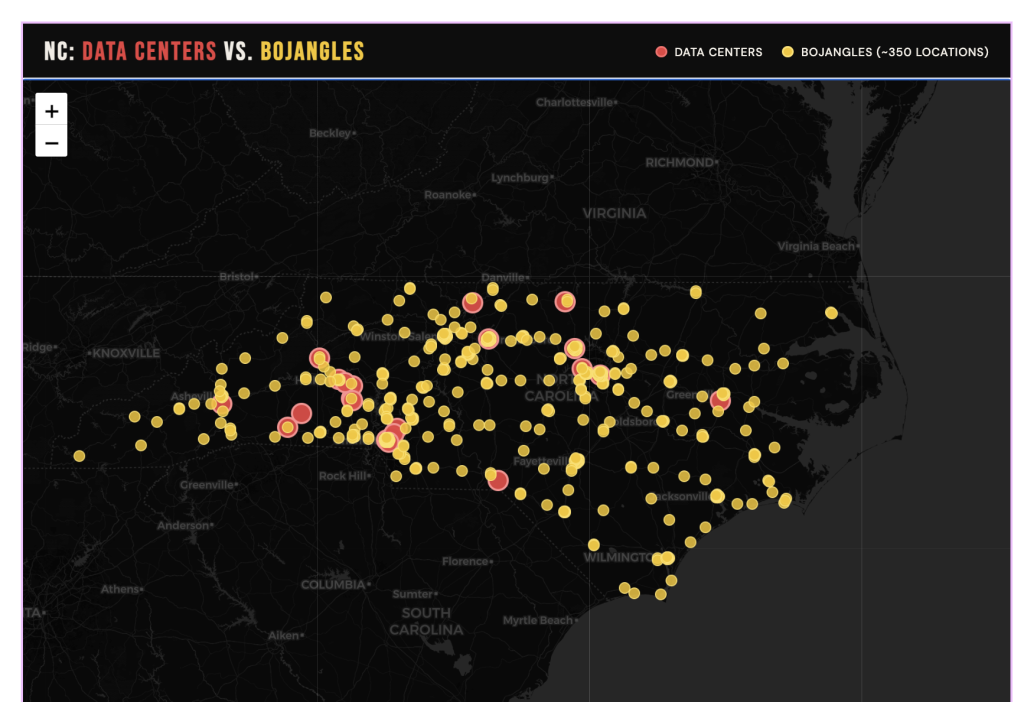
North Carolina has spent 50 years building 350 Bojangles. Big Tech is on pace to match that footprint in under a decade.
In 1977, two guys in Charlotte had a simple idea: sell Cajun-spiced fried chicken and made-from-scratch biscuits to hungry Southerners. Jack Fulk and Richard Thomas opened their first Bojangles on West Sugar Creek Road, and then — slowly, methodically, one town at a time — they did it again. And again. Maiden. Lenoir. Forest City. Fayetteville. Over fifty years, Bojangles became the closest thing North Carolina has to a civic institution, with 350 locations woven into the fabric of nearly every community in the state.
It took half a century to build that footprint.
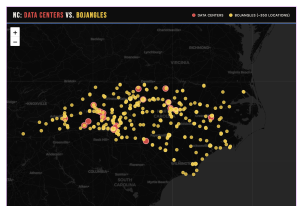
Now look at a map of where AI data centers are going. Then look at a map of Bojangles locations. The shapes are starting to rhyme.
There are already more than two dozen major data centers operating or under active construction in North Carolina — and that number is growing faster than anyone officially tracks. Apple has been in Maiden since 2010. Google landed in Lenoir in 2008. Meta followed in Forest City. But those early arrivals were a trickle. What’s happening now is a flood.
Microsoft has announced four separate data center projects in Catawba County alone — the same rural corridor where Bojangles has a handful of restaurants. Amazon is converting 800 acres of Richmond County farmland into what the company bills as its largest computing campus in the southeastern United States. WhiteFiber acquired a million square feet of former industrial space in Madison. ImpactData is building in Greensboro. Digital Realty filed for a 400-megawatt campus in Charlotte. The projects keep coming, announced in press releases full of job numbers and investment figures, with little else in the way of public deliberation.
Duke Energy, which powers much of the state, projects that data center demand in North Carolina could nearly double — from roughly 3 gigawatts to 6 gigawatts — within a decade. To put that in perspective: a single hyperscale data center can consume as much electricity as a small city. Bojangles runs on a deep fryer.
The comparison is not meant to be glib. Bojangles matters to North Carolina in ways that go beyond chicken and biscuits. It’s the place you stop on the way to the beach, the drive-through after the Friday night game, the breakfast sandwich your grandmother orders by name. It is embedded in the texture of daily life here in a way that took generations to achieve, because that kind of presence — the kind that actually means something to the people who live somewhere — cannot be announced in a press release.
Data centers are not restaurants. They don’t employ dozens of local workers per location. They don’t draw foot traffic. They don’t know your order. A hyperscale facility might create a few dozen permanent jobs while consuming the power and water of thousands of households. The towns that welcomed them — lured by tax incentives and the promise of economic development — are only beginning to understand what they actually signed up for.
In Tarboro, an hour east of Raleigh, the town council voted to reject a proposed $6.4 billion data center. In Apex, residents are fighting a “digital campus” that would displace 190 acres of farmland. In small communities across the state, the conversation is shifting from “will they come?” to “what happens when they do?”
Bojangles expanded the way things used to expand in North Carolina: because people were there, because there was demand, because someone in a given town wanted a franchise and had the capital to run one. The growth was distributed, human-scaled, and rooted in the communities it served.
What’s happening with data centers is different. The decisions are made in boardrooms in Seattle, Menlo Park, and Redmond, driven by the calculus of cheap land, favorable tax law, available power, and fiber routes — not by anything resembling community need. The towns are chosen; they do not do the choosing.
And yet the footprint keeps spreading. Town by town. County by county. Across the same map that Bojangles spent fifty years filling in.
At current rates of announcement and construction, North Carolina could have as many data center sites as Bojangles locations within this decade. That fact alone is remarkable enough. What it means for the communities caught in between — for their water, their power bills, their roads, their sense of place — is a question the state is still figuring out how to ask.
Jack Fulk opened his first Bojangles because he thought people deserved a good biscuit. Nobody asked the people of Catawba County whether they wanted to become the data center capital of the South.
That’s the difference. And it’s not a small one.